

By Dr. Suraya Ahmad Kamil, Universiti Teknologi Mara
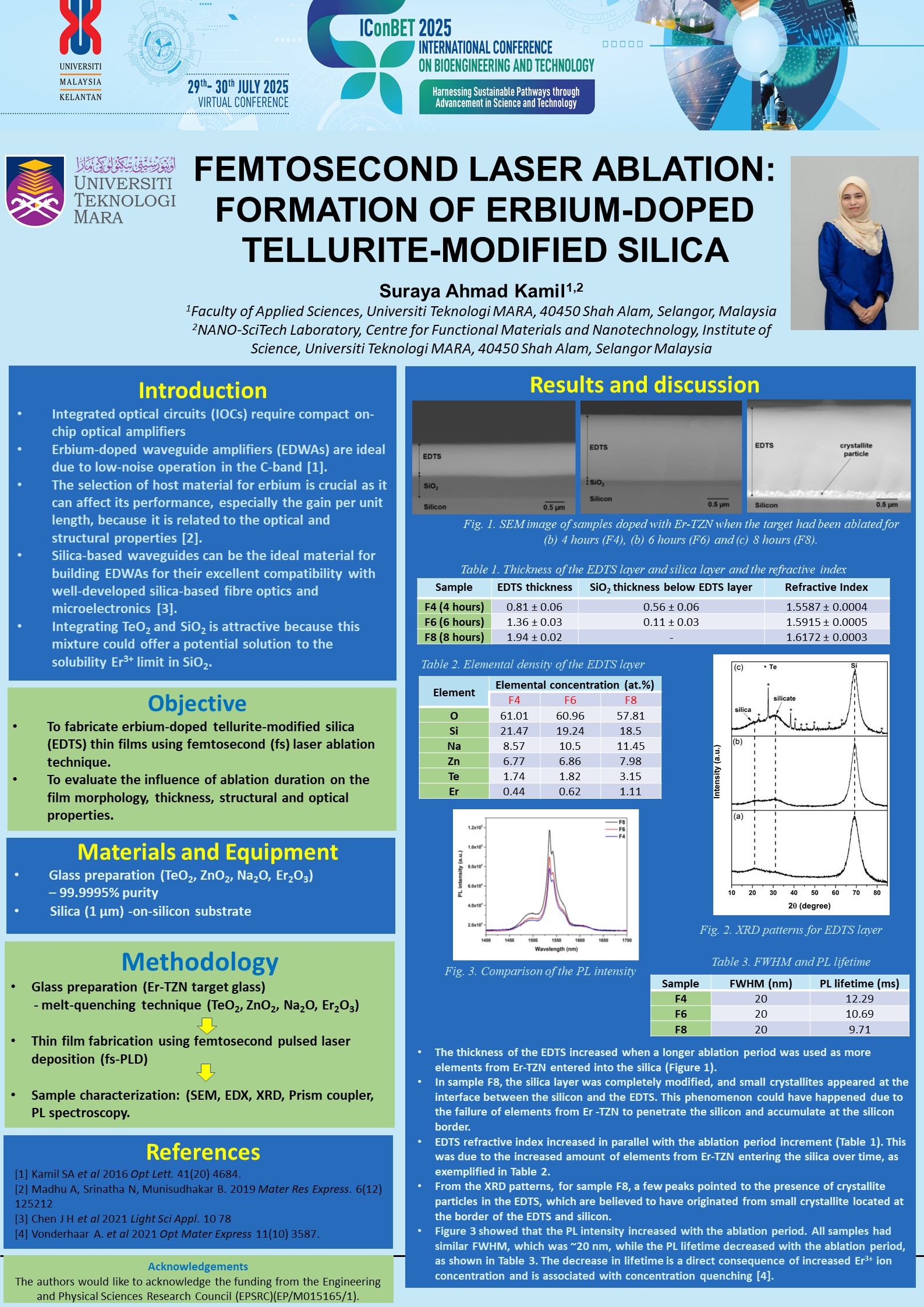
| 1 | Comment from NOR HAKIMIN BIN ABDULLAH, 2025-07-28, 10:00:13 PM | Please explain the conclusion of the research. | Answer from the presenter, 2025-07-29, 3:17:56 PM | In summary, erbium-doped tellurite glass containing zinc and sodium ions can be effectively doped into an SOS substrate to well beyond the usual solubility limit without detectable clustering by using fs-PLD. Film thickness increases with time; however, there is a limitation whereby the substrate becomes fragile at a certain period due to exposure to particle bombardment that has very high energy for a long period. The pristine silica layer thickness is reduced due to the modification of silica surface by the transformation into EDTS. The presence of crystallite particles which is mainly Te element at the interface between EDTS and substrate needed to be avoided as it would only contribute to the escalation of optical propagation loss for waveguide application. |
| 2 | Question from Assoc. Prof. Dr. An'amt Mohamed Noor, 2025-07-29, 12:57:40 PM | what the comparison previous published work? does this finding better than current laser ablation? | Answer from the presenter, 2025-07-29, 3:17:54 PM | For common laser ablation, it normally been reported to produce thin film on the substrate. For this study, the fs-PLD were used to ablate the target glass and produce laser-plasma plume. The plasma plume containing elements from the target glass will penetrate into the heated silica-on-silicon substrate. The heating of the substrate provides the activation energy needed to mediate this process and dynamically break and remake the strong Si-O-Si- covalent bonds in the silica. This helps the high-energy ions from the target glass penetrate into the silica and modify the host network. |