

By Ts Hanisah Izati Binti Adli, Universiti Malaysia Kelantan
| 1 | Question from Ms. NUR AINI BINTI MAT HUSSIN, 2025-07-29, 8:52:03 AM | Why did you choose the modified Hummer's method? | Answer from the presenter, 2025-07-29, 9:01:51 AM | I choose the modified Hummer's method because it offers a safer,more efficient, and scalable way to synthesize GO compared to the original method. This approach provides better control over oxidation, producing GO with abundant oxygen containing functional groups such as hydroxyl, carboxyl and epoxy groups. |
| 2 | Question from Mrs. Nurul Idayu Akma Binti Khairul Anuar, 2025-07-29, 8:52:07 AM | How do silver nanoparticles exhibit antibacterial activity? | Answer from the presenter, 2025-07-29, 9:16:52 AM | Silver nanoparticles (AgNPs) interact with bacterial cells in multiple ways. Thay adhere to the cell wall, which leaading to membrane destabilization due to their positive surface charge and interacting with negatively charge bacterial membrane. Inside the cell,AgNPs release Ag+ ions which bind to thiol groups in proteins,denature ezymes and disrupt DNA replication. |
| 3 | Question from Miss NURUL JANNAH BINTI IBRAHIM, 2025-07-29, 11:36:02 AM | How could the antibacterial properties of GO/Alg films be applied in everyday consumer products to improve public health and hygiene? | Answer from the presenter, 2025-07-29, 12:09:38 PM | GO/Alg films can be used in food packaging as biodegradable antibacterial packaging for fruits,vegetables,meats and dairy products. In healthcare,Go/Alg films can be used in wound dressing and bandages to prevent infections by acting as a physical and antibacterial barrier. |
| 4 | Question from BIBI INTISHAAR BINTI ABDUL HAKIM, 2025-07-29, 1:14:45 PM | Assalamualaikum, may I ask, why did you specifically choose the microwave method for synthesizing the GO/AgNPs composites? Were other techniques considered? | Answer from the presenter, 2025-07-29, 1:50:39 PM | Waalaikumussalam, thank you for your question. The microwave irradiation method was chosen for synthesizing the GO/AgNPs composites due to its significant advantages compared than conventional techniques. Microwave synthesis offers rapid and uniform heating, which helps accelerate the reduction of GO and promotes the efficient formation of silver nanoparticles (AgNPs). This method not only shortens reaction time but also enhances nanoparticle distribution within the GO matrix by reducing agglomeration and improving stability. Additionally, the microwave irradiation method is considered eco-friendly and energy-efficient, as it often requires milder conditions and avoids the use of harsh reducing agents. |
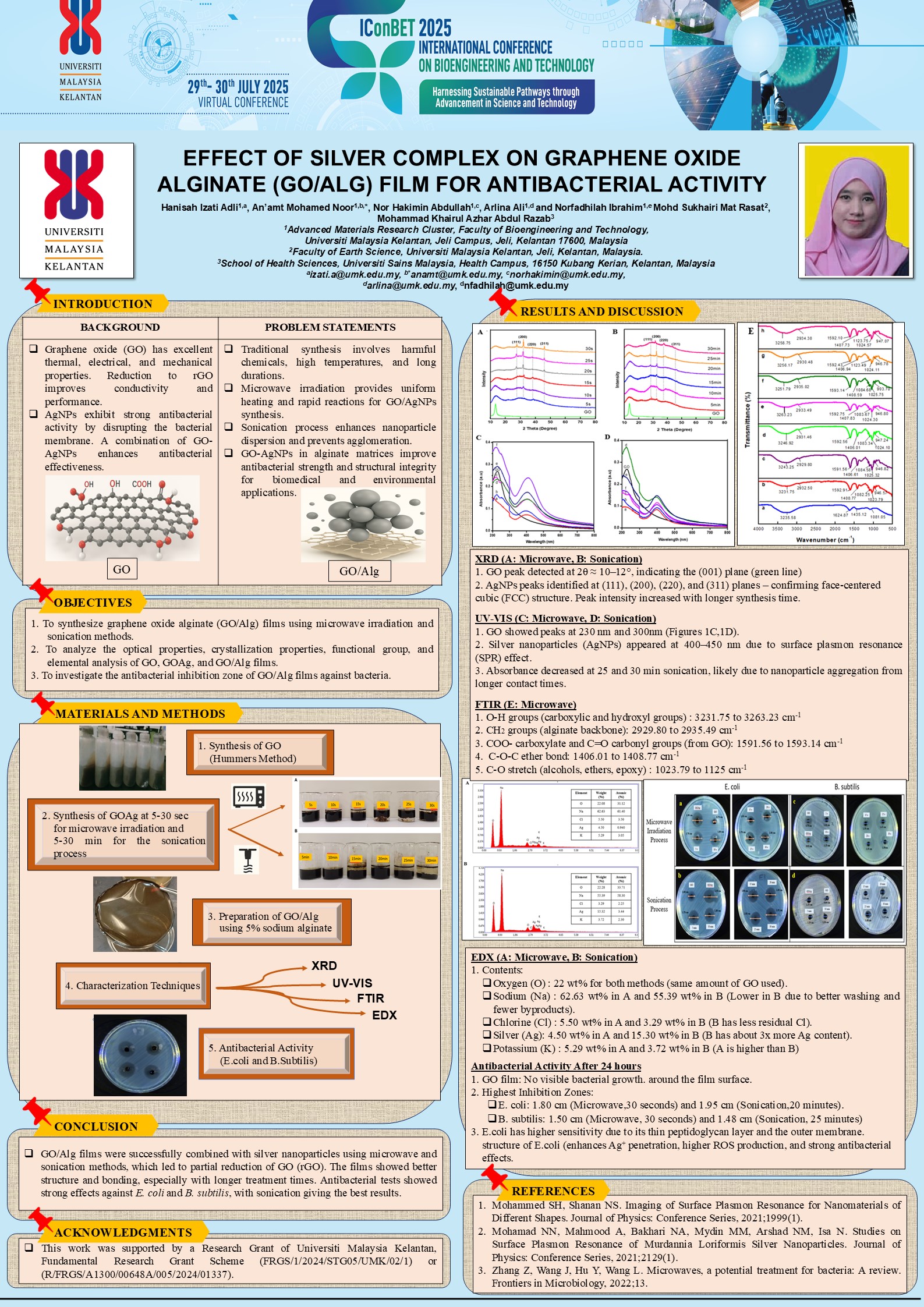
| 5 | Question from Mr. MUHAMAD AFIF ZAAFARANI BIN MUHAMAD AIDI, 2025-07-29, 1:58:29 PM | Which treatment gave the best antibacterial effect—microwave or sonication? And why? | Answer from the presenter, 2025-07-29, 2:16:23 PM | Thank you for your question. The sonication treatment demonstrated better antibacterial performance compared to microwave irradiation. The sonication method promotes better exfoliation of GO and more uniform dispersion of AgNPs due to cavitation effects. EDX data showed higher silver contents in sonicated samples (15.3% in sonication vs 4.5% in microwave), and UV-Vis results indicated stronger surface plasmon resonance (SPR) peaks, suggesting the presence of more active AgNPs. These factors contribute to better contact with bacterial membranes, resulting in larger inhibition zones against the tested bacteria. |
| 6 | Comment from Assoc. Prof. Dr. An'amt Mohamed Noor, 2025-07-29, 3:48:21 PM | Good poster | Answer from the presenter, 2025-07-29, 6:52:34 PM | Thank you Dr. I appreciate your feedback. |