

By Miss Bibi Intishaar Binti Abdul Hakim, Universiti Malaysia Kelantan
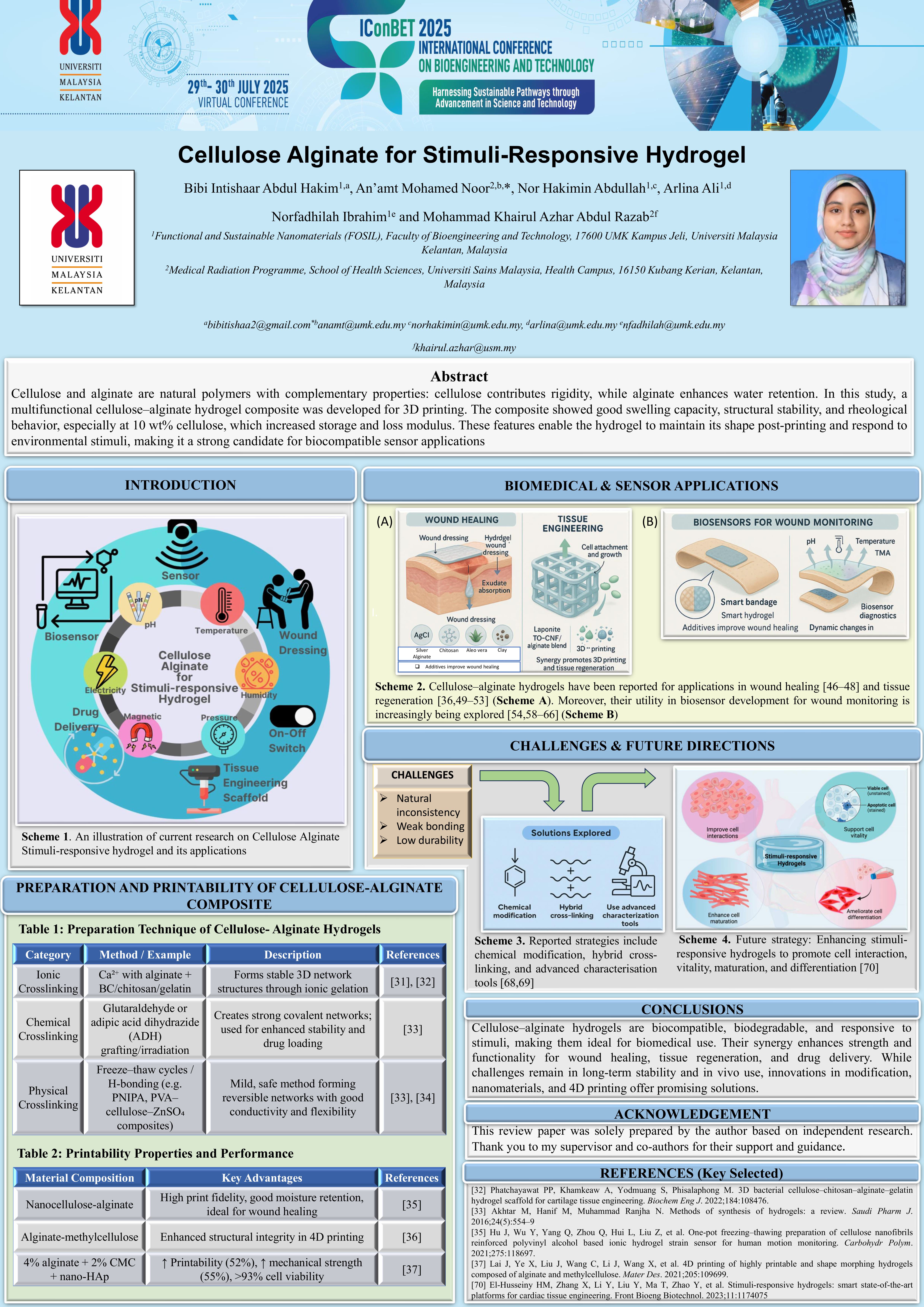
| 1 | Question from NUR NABILAH BINTI SHAHIDAN, 2025-07-27, 11:20:44 AM | 1. what are the parameters used to prepare your samples? 2. which one show the best for your application? | Answer from the presenter, 2025-07-29, 12:26:51 PM | 1. This work is actually a review paper, so I didn't prepare the samples myself. Instead, I gathered and analysed findings from various published studies. Each of those studies used different parameters, such as varying the concentration of cellulose and alginate, and applied different crosslinking techniques and processing methods like 3D printing or freeze-thaw cycles. My focus was to compare how these preparation choices affected hydrogel properties like swelling, mechanical strength, printability, and biocompatibility. 2. From what I reviewed, the formulation with 4% alginates and 2% carboxymethyl cellulose showed strong compressive strength and good cell viability, making it promising for biomedical use such as tissue engineering and wound healing. Meanwhile, nanocellulose-alginate hydrogels offered high print fidelity and good moisture retention, which is more suitable for wound dressing. So different formulations work best depending on whether the focus is on mechanical support, biocompatibility, or printing accuracy. |
| 2 | Comment from Assoc. Prof. Dr. An'amt Mohamed Noor, 2025-07-29, 8:19:31 AM | suggestion to revise the title by include "A review:..." or A Cellulose Alginate for Stimulus Responsive Hydrogel. | Answer from the presenter, 2025-07-29, 12:35:39 PM | Thank you for the suggestion. I agree that adding "a Review" at the beginning or end of the title would help clarify the nature of the paper. Since this work summarizes and analysed findings from various published studies, I am open to revising the title to "A Review on Cellulose-Alginate for Stimuli-Responsive Hydrogels." |
| 3 | Question from Mrs. Hanisah Izati Binti Adli, 2025-07-29, 12:42:22 PM | Assalamualaikum, may I know why stimuli-responsiveness is an important feature for hydrogels in biomedical applications and what benefits 3D printing offer in the development of hydrogel composites? | Answer from the presenter, 2025-07-29, 1:07:57 PM | Waalaikumussalam, thank you for your questions. Stimuli-responsiveness is crucial in biomedical hydrogels because it allows them to respond to changes like pH, temperature, or ionic strength conditions commonly found in the human body. For example, in wound healing, a hydrogel that responds to body temperature can control the release of drugs or growth factors at the wound site when needed. So the responsiveness is making the hydrogel more effective and smart in its function. Next, for 3D printing, it offers precise control over the shape, size, and internal structure of hydrogels. So, this is important for applications like tissue engineering and biosensing, where mimicking natural tissue or customizing to a patient's anatomy is essential. It also speeds up development and supports personalized medicine. |
| 4 | Question from Miss NURUL JANNAH BINTI IBRAHIM, 2025-07-29, 1:38:28 PM | What strategies do you recommend to enhance the stimuli-responsive behavior of cellulose-alginate hydrogels without compromising their biocompatibility? | Answer from the presenter, 2025-07-29, 1:59:19 PM | Thank you for that question. To enhance the responsiveness of cellulose–alginate hydrogels without affecting biocompatibility, we can add natural nanomaterials like nanocellulose to improve strength and sensitivity. Using physical crosslinking methods like freeze–thaw avoids toxic chemicals. Combining ionic and physical crosslinking helps create more stable gels. Adding smart polymers like methylcellulose also gives a better response to pH or temperature. These strategies keep the hydrogel safe while boosting performance. |
| 5 | Question from Mr. MUHAMAD AFIF ZAAFARANI BIN MUHAMAD AIDI, 2025-07-29, 1:47:09 PM | Why is printability important in hydrogel development for biomedical use? | Answer from the presenter, 2025-07-29, 2:02:35 PM | Thank you for that question. Printability is important in hydrogel development because it ensures precise shape control, which is essential for applications like wound dressings, tissue scaffolds, and implantable devices. A hydrogel with good printability maintains its structure after printing, supports cell attachment and growth, and fits the target site accurately. This enhances both the functionality and reliability of the hydrogel in biomedical use. |