SUBMISSION
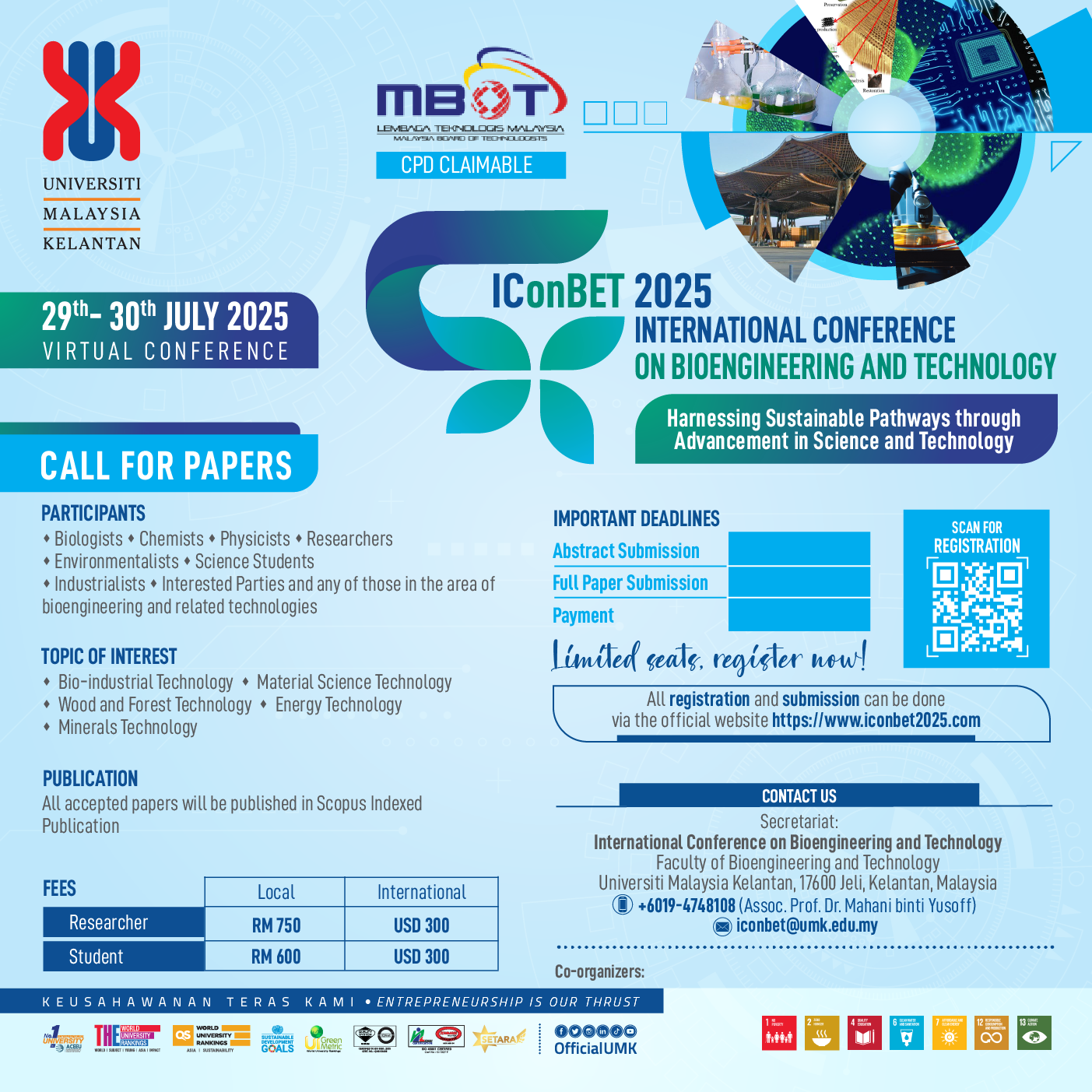
Submission of the abstract and full paper can be done through the IConBET2025 website after online registration. ONE registration is allowed to submit only ONE paper. The scientific committee will review the submitted abstract and full paper, and authors will be notified of the acceptance.
All accepted papers will be published in the Scopus Indexed Journal/Proceedings at an additional cost.
ABSTRACT GUIDELINES
- Your abstract must follow the following format :
FULL First Author1,a,*, FULL Second Author2,b and FULL Last Author3,c
1Full address of first author, including country
2Full address of second author, including country
3List all distinct addresses in the same way
aemail, bemail, cemail
* Please mark the corresponding author with an asterisk
Abstract. An abstract of 200 to 280 words that sketches the purpose of the study; basic procedures; main findings, its novelty; discussions and the principal conclusions, and any undefined abbreviations or references should not be included.
Keywords: List the keywords covered in your paper; These keywords will also be used by the publisher to produce a keyword index.
- The abstract should fill in the registration Form in this [LINK].
FULL PAPER GENERAL GUIDELINES
The template for the peer review process can be downloaded [here]. This is not the galley proof template for journal production but for peer review purposes only. The final format preparation will be instructed to you after the conference peer review process with comments and suggestions. The Conference Scientific Committee decides the journal selection based on the best match for the scope and field.
This manuscript must be written in British English, typed using Times New Roman (font size 11), and in MS Word. The page size should be A4, with a single column with a 2.54 cm margin on both sides. Line numbers should be given throughout the manuscript. All manuscript pages (including Tables and Figures) should be numbered. This manuscript should be divided into subtitles: Title, Abstract, Keywords, Introduction, Materials and Methods, Results and Discussion, Conclusion, Acknowledgements, and References. However, if you want to submit a review paper, you can structure the subtitle in your own creative way.
Manuscript Title
Title of up to 17 words should not contain any abbreviations and should be typed in Times New Roman of 16 pt. font and Bold in the latest MS Word format (DOCX). The title should be by the scope of the journal while not being obscure or meaningless. The author's name should be typed in 11 font and affiliations should be typed in Times New Roman of 10 font, italicized and centred.
Abstract
An abstract of 200 to 280 words that sketches the purpose of the study, basic procedures, main findings, its novelty, discussions and the principal conclusions, and any undefined abbreviations or references should not be included. It should be typed in Times New Roman of 11 fonts and justified
Keywords
Provide 4 to 7 keywords which can be used for indexing purposes. Keywords should not repeat the words of the manuscript title or contain abbreviations and shall be written in alphabetical order and separated by semicolon. Abbreviations should be defined at first mention and used consistently thereafter through the text. The abstract should be typed in Times New Roman of 11 font.
Introduction
The introduction should state the purpose of the investigation and identify clearly the gap of knowledge that will be filled in the literature review study.
Materials and Methods
The materials and methods section should provide detailed information to permit the experimental work's repetition. It should include clear descriptions and explanations of sampling procedures, experimental design, and essential sample characteristics and descriptive statistics, hypothesis tested, exact references to literature describing the tests used in the manuscript, number of data involved in statistical tests, etc.
Results and Discussion
The Results section should describe the outcome of the study. Data should be presented as concisely as possible - if appropriate in the form of tables or figures, although very large tables should be avoided. The discussion should be an interpretation of the results and their significance with reference to work by other authors. Please note that the policy of the Journal with respect to units and symbols is that of SI symbols.
Tables
Do not submit tables and graphs as photograph. Place explanatory matters in footnotes, not in the heading. Do not use internal horizontal and vertical rules. Tables should be called out in the text and should have a clear and rational structure and consecutive numerical order. All tables should be numbered (1, 2, 3, etc.). Give enough information in subtitles so that each table is understandable without reference to the text. For each table, please supply a table caption (title) explaining the components of the table. Identify any previously published material by giving the original source in the form of a reference at the end of the table caption. Tables should be with the captions placed above in limited numbers. Footnotes to tables should be indicated by superscript lower-case letters (or asterisks for significance values and other statistical data) and included beneath the table body. The caption of the table should be written in Times New Roman of 11 font.
Figures
Figures/ illustrations/line drawings, as well as colour photographs, should be in high-quality artwork. Ensure that figures are clear, labelled, and of a size that can be reproduced legibly in the journal. The caption of figures should be written in Times New Roman of 10 fonts. Following remarks should be applied to the figures:
- Each figure should have a concise caption describing accurately what the figure depicts. Please include/mention the fig with a respective number in the text before displaying the Fig graphic in the manuscript.
- Figure captions begin with the term Fig. Figures should be with the captions placed below in sequence number.
- No punctuation is to be placed at the end of the caption.
- Identify all elements found in the figure in the figure caption and use boxes, circles, etc., as coordinate points in graphs.
- Identify previously published material by giving the source in the form of a reference citation at the end of the figure caption.
- If you obtained the fig from another source, please ensure you have been given the right to reproduce the fig. Supply the proof to us. This is quite common for a review paper.
Conclusion
This section should highlight the major, firm discoveries, and state what the added value of the main finding is, without literature references.
Acknowledgements
Acknowledgments of people, grants, funds, etc. should be placed in a separate section before the reference list. The names and numbers of grant/grants and funding organizations should be written in full. Financial support affiliation of the study, if exists, must be mentioned in this section.
References
All the references should be written in the following format:
Text:
All publications cited in the text should be presented in a list of references following the text of the manuscript. In the text, refer to references by a number in square brackets on the line [1], and the full reference should be given in a numerical list at the end of the paper.
List (in the reference section):
- Fish JC, Lee S W. Delamination of tapered composite structures. Engineering Fracture Mechanics, 1989;34(1):43-54.
- Tsai SW, Hahn HT. Introduction to Composite Materials. Westport: Technomic, 1980.
- Bradley WL. Relationship of matrix toughness to interlaminar fracture toughness. In: Friedrich K, editor. Application of Fracture Mechanics to Composite Materials. Amsterdam: Elsevier, 1989. p.159-187.
- Kairouz KC, Heath RJ. Fracture of ply drop-offs in composite structures. In: Proceedings of ECCM-7 Conference. London, May, 1996. p.79-85.
Journal article
Fish JC, Lee S W. Delamination of tapered composite structures. Engineering Fracture Mechanics, 1989;34(1):43-54.
Book
Tsai SW, Hahn HT. Introduction to Composite Materials. Westport: Technomic, 1980.
Book chapter
Bradley WL. Relationship of matrix toughness to interlaminar fracture toughness. In: Friedrich K, editor. Application of Fracture Mechanics to Composite Materials. Amsterdam: Elsevier, 1989. p.159-187.
Conference paper
Kairouz KC, Heath RJ. Fracture of ply drop-offs in composite structures. In: Proceedings of ECCM-7 Conference. London, May, 1996. p.79-85.
Please note that references to electronic sites should only occur if there is an expectation that the site will be maintained.
PEER REVIEW PROCESS:
These are the steps involved in the paper submission and review process:
- Full papers should be directly uploaded through the online system on the official website of the organization or conference.
- Once the full paper is submitted, it undergoes an initial screening process to ensure its academic validity and relevance. The paper is checked using Turnitin or a similar plagiarism detection tool during this stage. Only papers with Turnitin results below 30% are considered for peer review. Authors may be encouraged to revise their papers based on this screening.
- The editorial team selects two reviewers who are experts in the same field as the submitted paper. The peer review process follows a single-blind format, where the reviewers are aware of the authors' identities, but the authors do not know the reviewers' identities.
- Based on the comment, the conference editor will determine the suitability and the scientific merit of the manuscript for journal selection, either MyCite or Scopus Journal and notify the author of the result.
- If the manuscript is selected for Scopus Journal, the author needs to agree with the additional fees that will charged after the second peer-review process by the Journal Editor. If the journal rejects the manuscript, the manuscript will still be considered for other MyCite journals.
- Suppose the manuscript is selected for MyCite Journal, but the author still wants to publish in the Scopus Indexed Journal. In that case, the manuscript can be retracted from this conference, but the conference fee is non-refundable.
- The editorial team holds the final responsibility for the selection of every accepted paper. The decision to accept a paper is based on the feedback and comments provided by the reviewers.
- All authors are notified of the final decision regarding their paper. If a paper is accepted with revisions, the authors are asked to provide a revised version, incorporating the comments and suggestions provided by the reviewers.